Skip to content
Djanggi
Feature

Funds shaped around your group

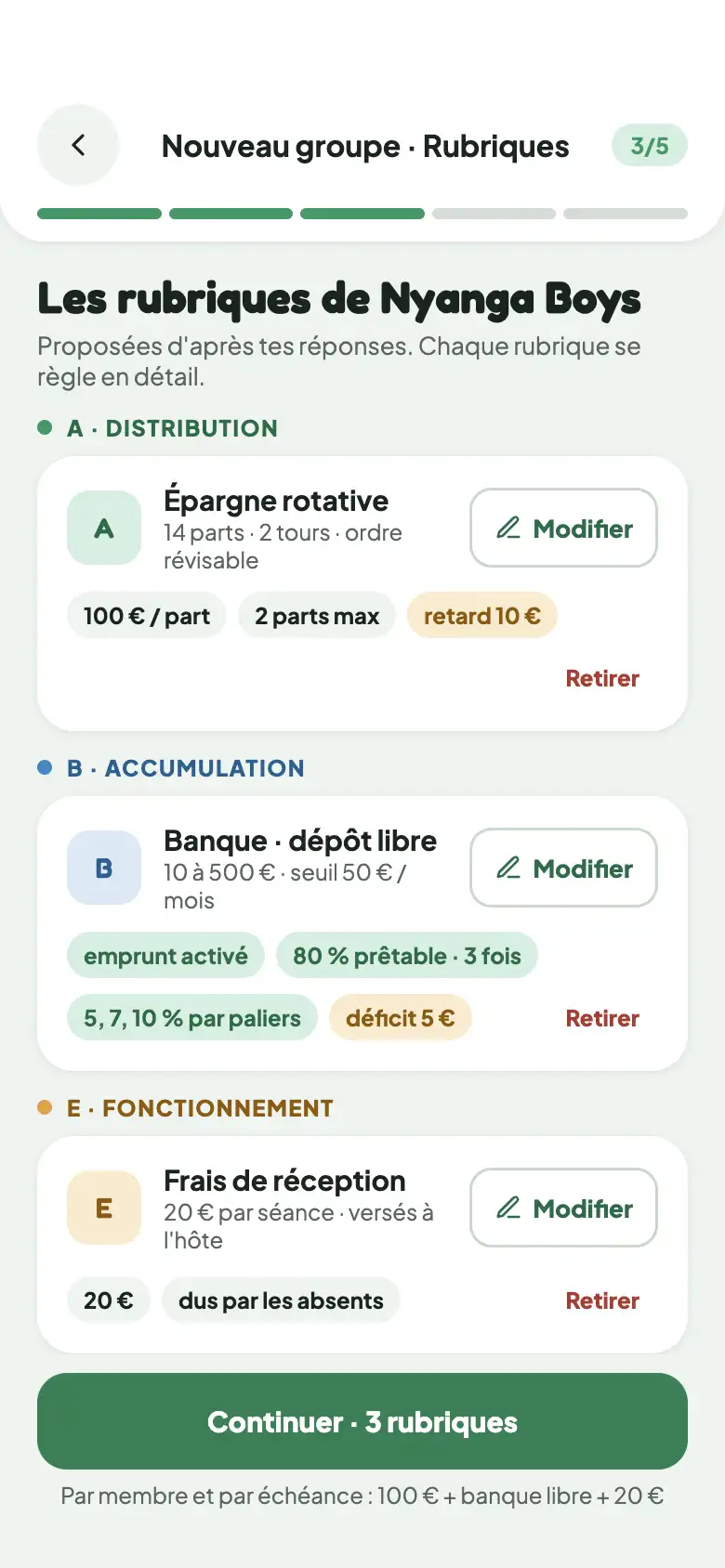
No two tontines are alike. In Djanggi, the group builds its own funds and sets every rule, instead of bending to a single template.

A group's funds in Djanggi, sorted by family, with their settings

Five families to cover everything

Every fund belongs to a family, which says what happens to the money paid in.

  • Distribution: the pot collected at each round is handed to one member.
  • Accumulation: the money stays in the group until the end of the cycle or until the goal is reached.
  • Credit: a fund members can borrow from.
  • Solidarity: funds to support a member.
  • Running costs: the group's shared expenses.

Eleven categories, ready to set up

Within each family, you pick the category that matches the way your group does things.

  • Rotating savings and bidding tontine.
  • Open deposit, share-based savings, personal goal and group project pot.
  • Lending fund.
  • Emergency fund and one-off appeal.
  • Running costs.
  • Investment fund, planned for a future version.

Created in four steps

You choose the family, then the category, you adjust the settings, and a summary shows you what each member will pay in at each round.

Fines attached to each fund

Lateness, absence, bank below the threshold: for each fund, the group decides what triggers a fine, how much it is and which fund receives it. The app suggests it, the committee applies it.

Frequently asked questions

Do we have to use every family?
No. A group can make do with a single fund, for example rotating savings.
Who sets up the funds?
The committee, when the group is created. Each member can then read the full rules before joining.

Try it with your group.

2-month trial, no card needed. Members pay nothing.

2-month trial, no card needed. iPhone and Android.2-month trial, no card needed. Also on Google Play.2-month trial, no card needed. Also on the App Store.

Djanggi2-month trial, no card neededApp StoreGoogle PlayDownload